Dignity Is a Human Right

Dignity Is a Human Right
Pro Bono Work Bolsters the Winston-Salem Community
By Hannah Callaway
The Pro Bono Project has been a staple of the Wake Forest University School of Law for more than 15 years, encouraging students to engage the community through service to others. Unlike ad hoc pro bono opportunities at other law schools, Wake Forest Law offers a fully-realized program with a student-run board, faculty directors, and standing initiatives where students work under the supervision of licensed attorneys to serve a variety of unmet legal needs in Winston-Salem and Forsyth County. Last school year, students contributed an impressive combined 5,856 pro bono hours.
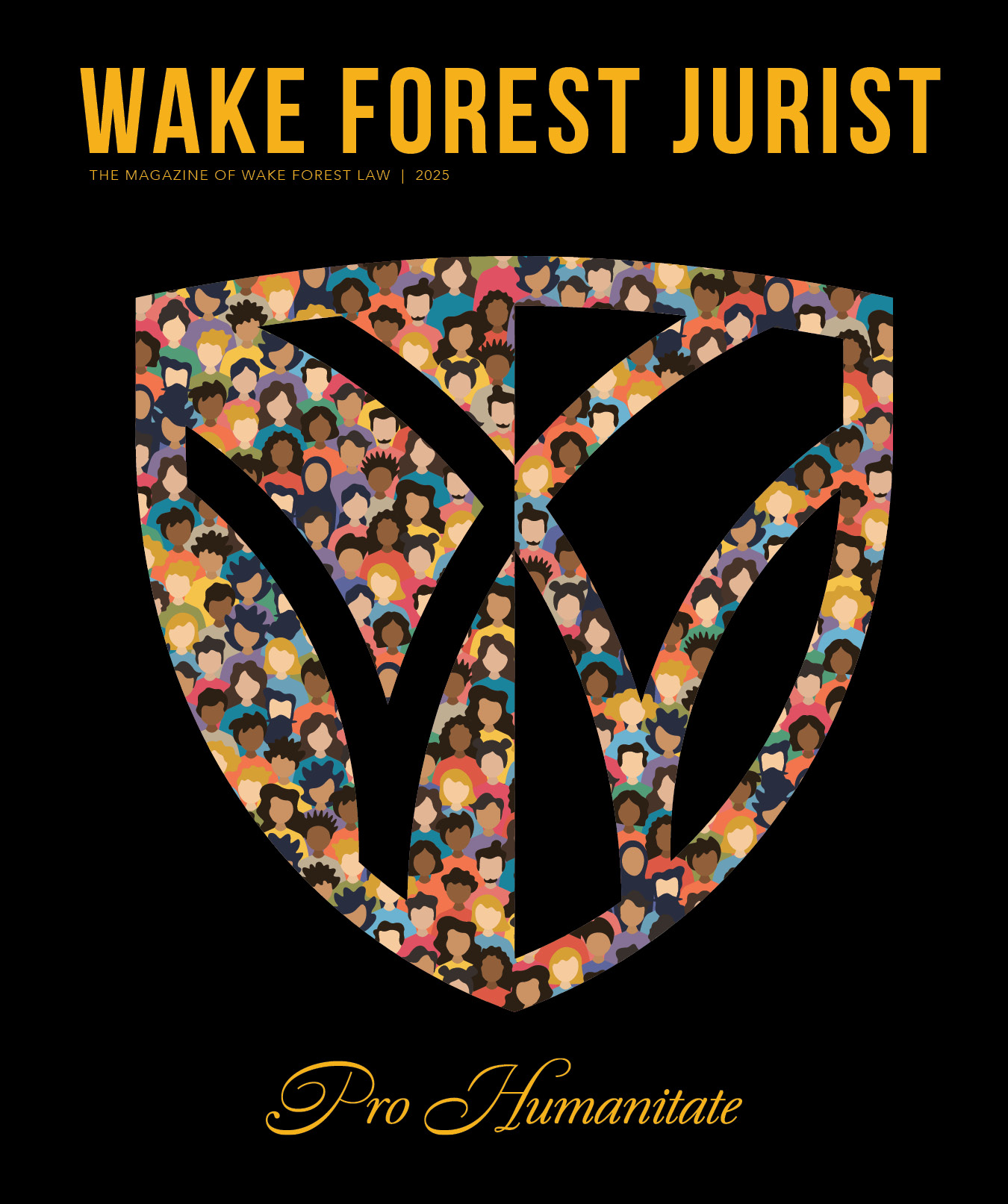
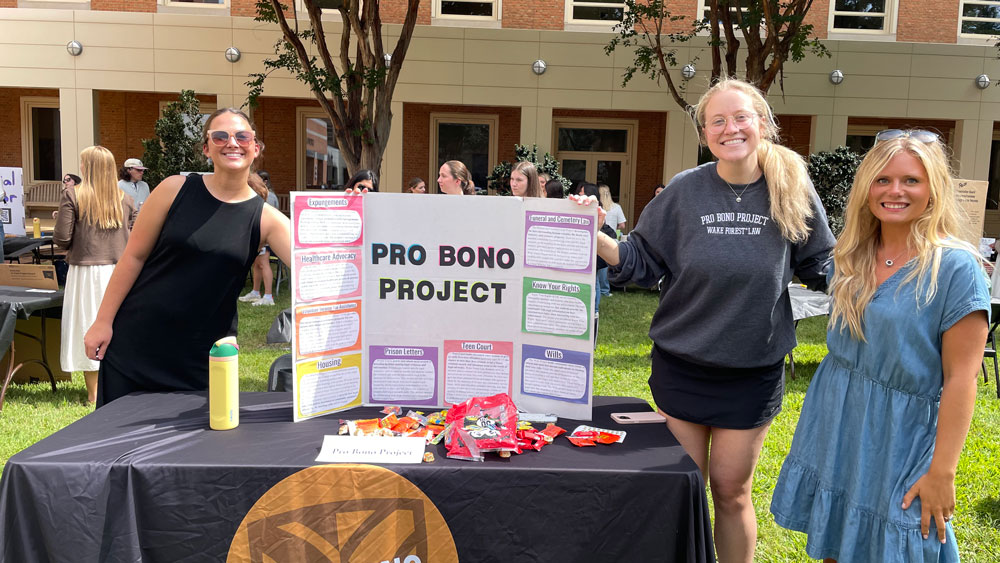
“The Pro Bono Project emphasizes that dignity is a human right,” says Mae Zeitouni (JD ’25), who recently completed a year as deputy director of the Project. Indeed, dignity is at the heart of this essential work, which focuses on supporting individuals from myriad backgrounds through the following projects: Expungements, Wills, Housing, Know Your Rights, Healthcare Advocacy, Prison Letters, Teen Court, Volunteer Income Tax Assistance (VITA), and Funeral and Cemetery Law.
This pro bono work addresses some of the most critical areas of need in the community, explains the Pro Bono Project’s Faculty Advisor and Legal Aid attorney Corey Frost. “Attorneys in private practice have very limited ability to provide free legal services for people who need, for example, a simple will or a power of attorney document,” he says. “This is where law students can help to fill the gap.” For most projects, experienced student coordinators help train new students. Supervising attorneys are then on hand to review work and share feedback. In most instances, students work directly with clients.

Pro Bono Project clients have little to no barrier of entry to receive services, and intake events are strategically held in widely-accessible areas such as the Forsyth County Central Library. It’s important to meet the community where they are, says former Pro Bono Project Executive Director Mary Catherine Baker (JD ’25). “I’ve found there is sometimes a disconnect between law students and the general public,” she says. “There’s a lack of understanding about what the average person goes through. Most people cannot afford a lawyer; they don’t have access to an attorney. We experience a level of privilege by attending law school, and it’s good to redirect some of that back into the community.” Zeitouni agrees:

Mae Zeitouni (JD ’25)
Participating in the Pro Bono Project is encouragement to remind yourself why you’re here and why you’re doing this. Often, people come to intake events—not only because they want help, but because they need it. They’re in a vulnerable place. It reminds me of the importance of community and that I can help to make a difference.
This deep appreciation for serving the community led Baker and Zeitouni to propose that students complete at least 10 pro bono hours during their 1L year, which was instituted during the 2024–2025 school year. The initiative has been successful, and has encouraged students to give even more of their time to local causes. This year, a record number of Wake Forest Law 1L students were named to the North Carolina Pro Bono Honor Society—which requires at least 50 pro bono hours logged in the span of a year. With 99% participation, 1L students together contributed nearly 3,000 pro bono hours of work throughout the year.
However, one challenge is that interest is high and not every student can work with their first-choice project. Frost and the student-led board are intentionally creating more ways for students to become involved and are adding multiple opportunities throughout the year for project training. He also hopes to offer additional non-project-specific services in the future. “I want to be nimble,” he explains. “I’d like for the Pro Bono Project to be able to respond to things that arise when political winds change or when the legal landscape changes.” Last year, the Pro Bono Project organized a name change clinic. In the coming year, they’re considering a power of attorney clinic for undocumented immigrants who want to support their children in the event of a deportation. “The need is infinite,” Frost adds. “We’re only limited by initiative and by the availability of our students.”
Wake Forest Law alumni are encouraged to participate in the Pro Bono Project as supervising attorneys.
Reach out to for more information about how you can help.
A critical pillar of support for the local community, the Pro Bono Project also delivers substantial benefits for students. Projects provide a low pressure opportunity to explore unfamiliar areas of law. The work, in turn, includes real-world interviewing, counseling, and more. Many students, for example, do not have experience talking to members of a different community or a different socioeconomic status. “The way you speak in a law school class is very different from how you speak to clients,” Frost says. “These projects are a safe and controlled environment to gain that experience.” The work also introduces students, who come from all over the country, to the Winston-Salem community—the people, the culture, and the available resources.

“Working directly with so many people makes you view the world differently,” says Baker. “You have to confront many of your beliefs about the world, too. It’s a full range of human emotion.” She uses the alternative justice program Teen Court as an example of the dichotomies often found in pro bono work. “I experienced kids who were crying and scared alongside kids who were rough and trying to challenge me. Both need the same support and should be treated the same.” All individuals, regardless of background or circumstance, deserve the same access to legal and support services.
“Everyone benefits from pro bono work,” she continues. “I appreciate that Wake Forest Law makes this a lifelong learning opportunity. We engage with pro bono work, not so we can talk about it in a job interview or attract the right law firm, but because at the end of the day we have a desire to meet the need.”

Mary Catherine Baker (JD ’25)
Everyone benefits from pro bono work. I appreciate that Wake Forest Law makes this a lifelong learning opportunity. We engage with pro bono work, not so we can talk about it in a job interview or attract the right law firm, but because at the end of the day we have a desire to meet the need.
Donate to Pro Bono
Give a financial gift to the Wake Forest Law Pro Bono Project.
Propose an Event
Community members are invited to submit Pro Bono events for consideration.