From the Jurist
Empowering Little Voices
Iris Sunshine (JD ’89) Dedicates Her Career to Children’s Law
By Hannah Callaway
With vivid detail, Iris Sunshine (JD ’89) remembers the day she visited the judge’s chambers to discuss her parents’ custody agreement. Ten years old at the time, her parents had divorced several years prior. “I was wearing a flowered dress and a cardigan,” she recalls, “and the office felt so big. I was just a little kid.” Through a long series of questions, the judge sought to gather her perspective on the arrangement. With a lawyer by her side, Sunshine shared her personal experience and also spoke on behalf of her two younger brothers. When she left the meeting, she had one thought:
“That’s what I want to do when I grow up.”
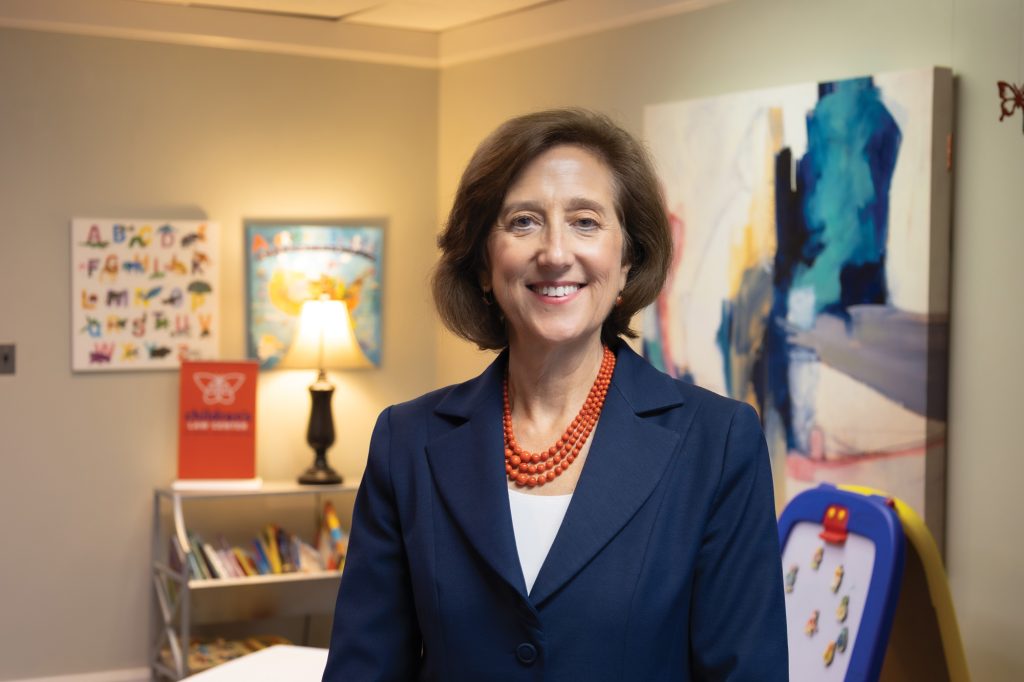
As the Executive Director of the Children’s Law Center of Central North Carolina, she’s achieved her dream of advocating for children so their voices can be heard. Headquartered in Winston-Salem and serving both Forsyth and Guilford counties, the Children’s Law Center focuses on advocacy for children in domestic violence, high-conflict custody, and rights of children in public education cases. Founded in 2005 by Penny Spry (JD ’82) and Amy Kuhlman, Sunshine joined the team in 2008 as a staff attorney—their first hire—and was appointed executive director following Spry’s retirement in 2011. The staff and their offerings have expanded over the last 20 years, but the mission remains the same. “We are champions for children,” says Sunshine. “And we are their legal advocates. We raise their voices to be heard when it is needed the most.”
While the seed was planted during Sunshine’s youth, her desire to advocate for children grew during her time at Wake Forest Law. Following graduation from Cornell University’s School of Industrial and Labor Relations, Sunshine spent a few years gaining experience as a lobbyist for the International Ladies’ Garment Workers’ Union in Washington, DC, before applying to law school. She soon moved to North Carolina, got married, and began school—all in the same summer.
Though many professors and classes strengthened her knowledge and honed her skill, Sunshine’s clinic course, taught by Dean James Taylor and Professor Carol Anderson, was particularly impactful. “The fact that Wake Law had a clinic offering was something that attracted me to the school in the first place,” she explains. “I liked that you were assigned something different than what you would otherwise be inclined to do.” Her assignments included externships with Womble Carlyle (now Womble Bond Dickinson) and the District Attorney’s office. Sunshine describes the experience as transformative and a time when things began to coalesce for her. She found a natural fit working in the DA’s office and came on board as an Assistant District Attorney after graduating and successfully passing the North Carolina Bar Examination.
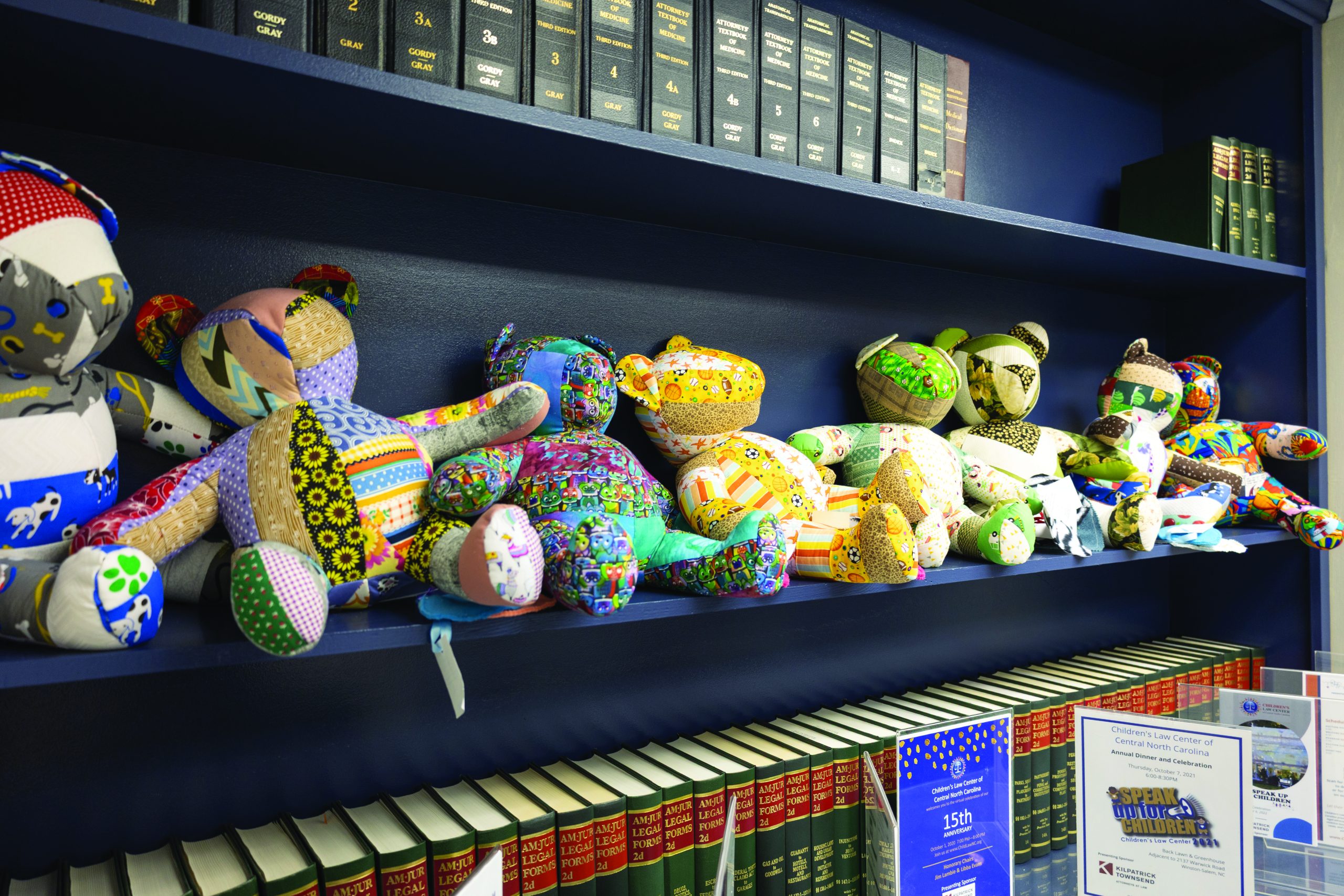
The Children’s Law Center partners with Project Buddy Bears of NC, Inc., a local nonprofit that makes bears for first responders and family services to give to children in situations of trauma or distress. Learn more about Project Buddy Bears.
As a prosecutor in district court, Sunshine began championing the needs of children as she rotated through traffic, criminal, juvenile, and domestic cases. “There were many opportunities to learn, and try child abuse cases,” she recalls, “and while not everybody wanted to tackle those, I did.” In superior court, she continued her focus on similar cases and other criminal matters until her retirement from the DA’s office—a move that allowed her to shift her energy to focus on her young children. In 2008, Sunshine had the opportunity to return to Wake Forest Law by covering the sabbatical of her former professor, Carol Anderson, and leading the clinic course that had meant so much to her nearly 20 years prior. It was an opportunity to connect with lawyers and students in the community before a brief return to the DA’s office to backfill the leave of a staff member. “It was like riding a bike,” she says of serving once more in domestic and juvenile court.

After having been introduced to the Children’s Law Center earlier in the year by a former mentor, Sunshine landed at the Center in November 2008 with a new part-time role. Her work there has been deeply meaningful, as each program impacts long-term outcomes for children. “What is best for the children so often falls through the cracks,” Sunshine explains, in domestic violence or high-conflict custody cases. Toxic and traumatic childhood experiences, such as parental substance abuse or violence in the home, can cause lasting poor mental and physical health outcomes. Every case they counter is different.
The Center provides Guardian ad Litem (GAL) advocates for children, as appointed by the courts. In North Carolina, GALs in juvenile court proceedings can be practicing lawyers, staff, or volunteers who complete a training program and work under supervision of staff. Children’s Law Centers’ Staff Attorneys and Pro Bono Attorneys are highly trained, experienced, and prepared to serve as GALs for children. They do not offer legal advice or representation, but instead make critical assessments to help determine the best possible outcomes for the child to which they are assigned. “We have access to court, law enforcement, school, and medical records,” explains Sunshine, “along with the ability to interview all parties and relevant collateral witnesses.” GALs will often visit children in both their home and school environments. Child interviews are conducted with age-appropriate questions and seek clarity around the child’s experiences, feelings, and observations. At the conclusion of their assessment, the assigned GAL will present their findings and recommendations to the court. Last year, the Center supported over 200 children across more than 150 cases.
“My team is dedicated, compassionate, and tenacious,” says Sunshine. “And they really connect with these children. They get down on eye level; they sit on the floor to play; they kick soccer balls around with them.” Fostering connection and earning their trust is important. A brief but powerful moment stands out in Sunshine’s memory that illustrates the close bond:
“I was working with a little boy and drove out to complete a home visit. He came outside to greet me and he hugged me. He grabbed me around the legs and I thought, ‘He knows I’m his person and that I’m here for him.’ He trusted me and he needed that connection. That’s why we are here. That’s why we do what we do.”
Iris Sunshine (JD ’89)
In 2023, the Center expanded their footprint through a new education and advocacy program. “Children are entitled to a free and appropriate public education,” says Sunshine, while acknowledging gaps that exist in the public school system today. The Center provides direct legal representation for children who have individualized education plans (IEPs) that are not being enacted and to children who are involved in exclusionary school discipline matters—such as long-term suspension or expulsion. A big component of the program, Sunshine explains, is education. “There’s a need for parents to be educated about what their rights are,” she says. “We partner with established community agencies or other organizations who help to equip and educate parents with the tools they need to become advocates.”
Sunshine continues to work on the ground level by working with volunteer GALs on cases, and filling in occasionally when someone can’t make a court date. But in her role as Executive Director, she is largely focused on strategically increasing capacity to sustain the Center’s programming, which in turn extends the organization’s impact and ability to serve more children. “My role as executive director is to be promoting our work and our vision for the future across the community and with statewide partners,” she explains. “I’m sharing the issues children are experiencing and the physical, mental, and emotional impacts. And I’m raising awareness as to how we are helping to mitigate those adverse experiences by building trust with the children and students we serve.” She has also maintained a connection between the Center and Wake Forest Law welcoming law student interns.
At the heart of her work over the last 35 years, Pro Humanitate shines through. “My commitment to the protection of children is what I’m most proud of,” says Sunshine. “I’ve always stood for the same thing.” And through her compassionate service, she inspires the next generation. “Some of the children we serve have shared they’d like to become a lawyer someday, or they’d like to be a lawyer for children,” she says. “It’s a full-circle moment.”