
Honoring the Mystery of Our Roots: The Origins of the Wake Forest Law Review
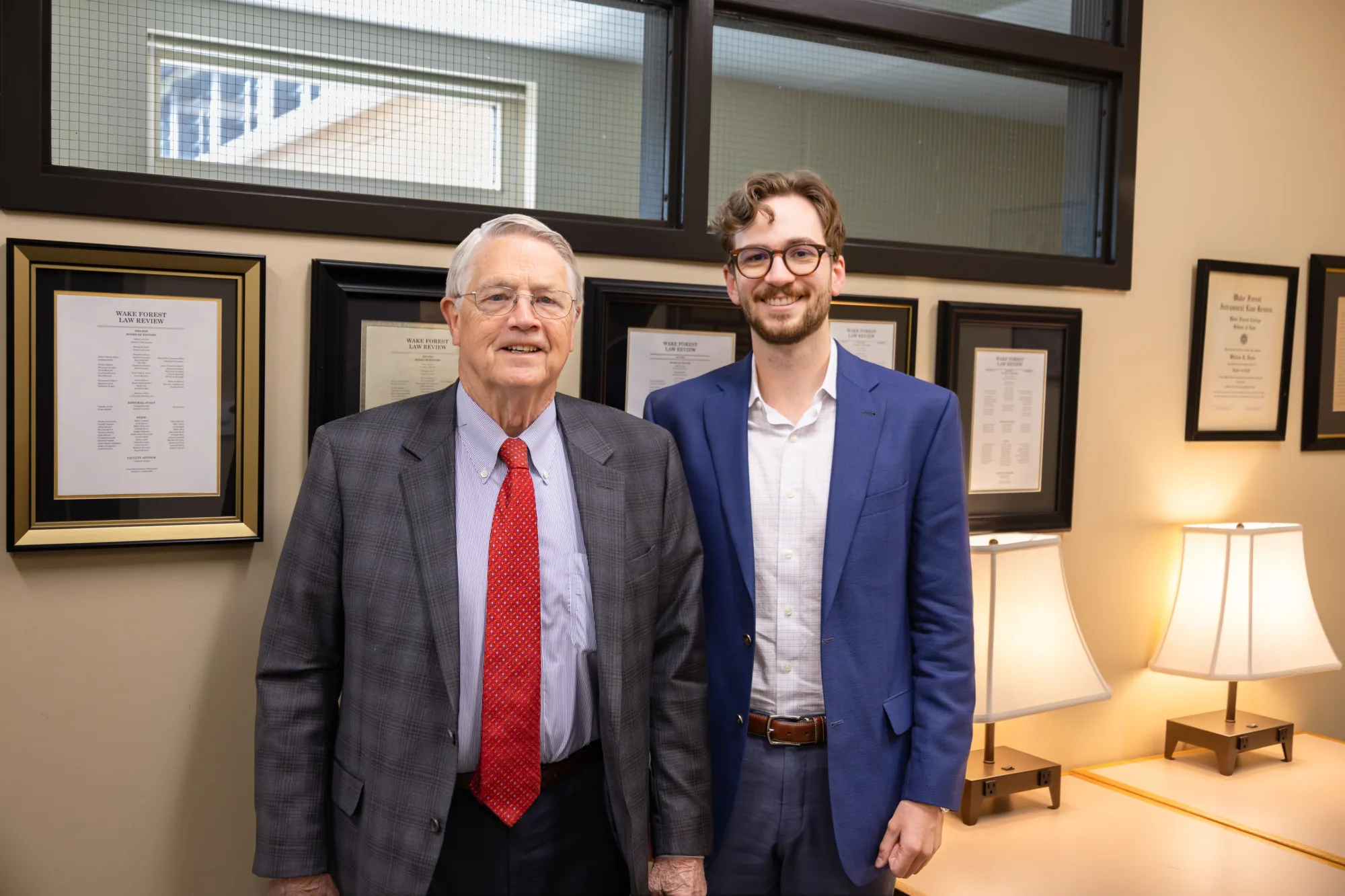
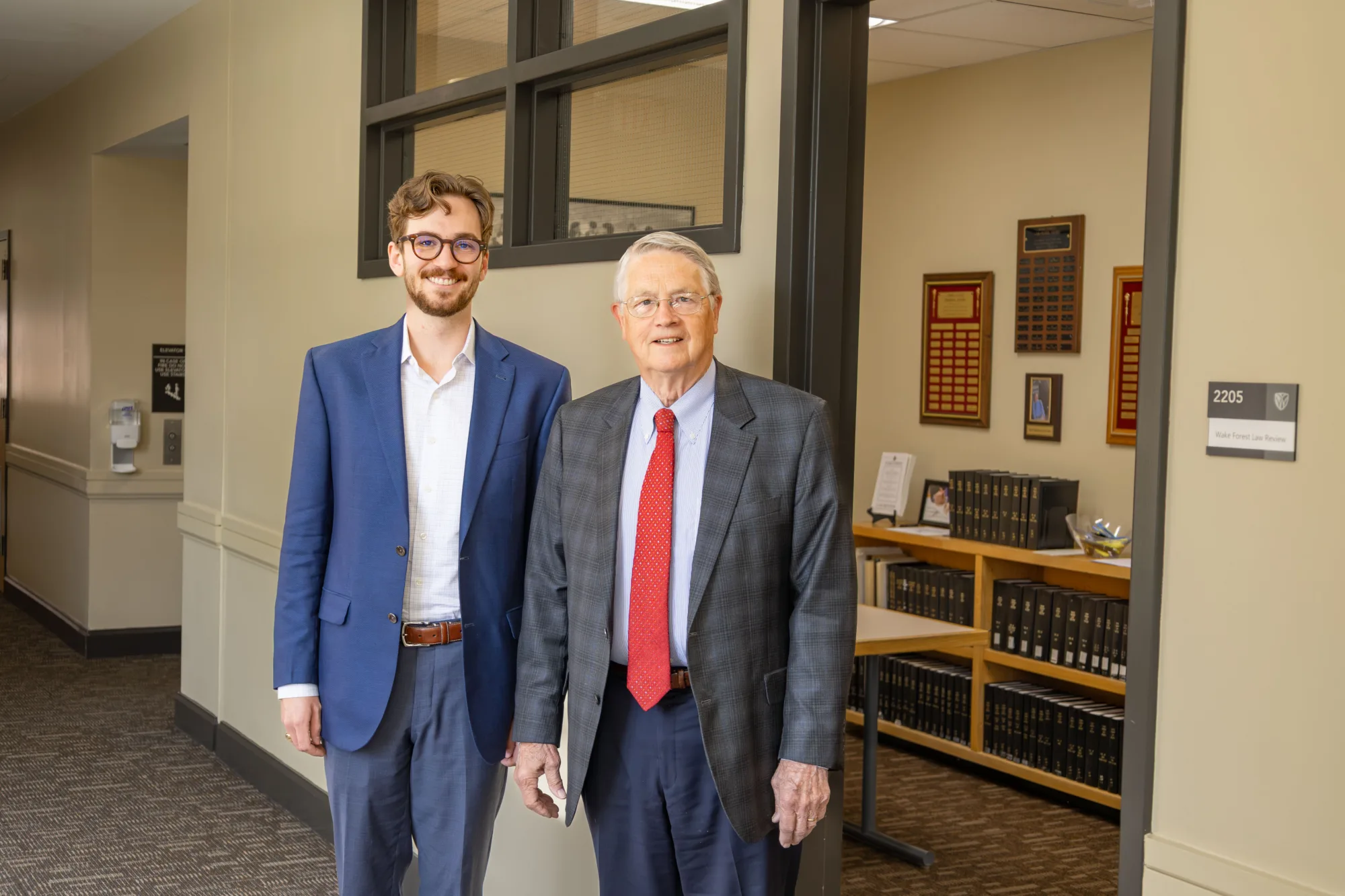
It was Law Alumni Weekend 2025 when Bill Davis (JD ’66) and Will Boyce (JD ’26) first met in what felt like a cosmic alignment of the universe. A gentleman lawyer with an impressive 59-year career and a young man soon to embark on his own legal career. A founder and an editor of the first Wake Forest Law Review and the current editor-in-chief, their time at Wake Forest Law separated by six decades. The articles may not be typed on an Underwood anymore, but the heart of the Law Review has remained the same since its founding …And, in many ways, so too has the heart of Wake Forest Law.
The More Things Change, the More They Stay the Same
Described in an article as “A crack corporate litigator with the charm of a country lawyer,” and by his longtime partner and friend Wrennie Pitt as, “the embodiment of kindness,” Bill Davis is a legal pillar of the state—and about as North Carolina as they come. Born in Raleigh, Bill moved to Winston-Salem at a young age and earned an undergraduate degree from Davidson College and an MBA from UNC. During his two years in the Army with the 101st Airborne Division, he decided he wanted to attend law school, and what better place to do so than in an excellent law school right in his own backyard. He enrolled at Wake Forest Law in 1963.
In 1980, Bill went on to establish the law firm, Bell, Davis & Pitt, with Frank Bell and Wrennie Pitt. Among his many achievements and accolades (too many to list in their entirety), Bill served as president of the North Carolina State Bar, a founder and president of the North Carolina Association of Defense Attorneys, national president of the Wake Forest Law Alumni Association, and so much more.
Among those accomplishments is the recent establishment of the Bill and Myrtie Davis Law Scholarship, a need-based scholarship awarded to students who graduated from an undergraduate college, university, or high school in North Carolina. “I benefitted from a scholarship, and Wake Forest Law meant a lot to me,” says Bill. “So I wanted to do something to show appreciation for that. It’s about helping your community, right? There are so many students from small towns in North Carolina who would like to go to law school and just can’t afford it.”
For Will Boyce, who graduated magna cum laude from Southern Methodist University (SMU) in 2022, law school was a way to continue pursuing some of the skills he was passionate about. “I always really loved reading, researching, and writing. I majored in English, Spanish, and business during undergrad, and I considered going into consulting, but that never really clicked for me. I started hearing about law school from friends who had recently begun their JD programs, and it seemed like that would be a good way to continue doing the things I enjoyed in undergrad,” says Will. He entered Wake Forest Law in 2023, surrounded by 173 classmates, all ready to embark on a rigorous, life-changing three-year journey.
During Bill’s time at Wake Forest Law, the entire school comprised 181 students. All of the first-year students took classes together. “You got to know people really well,” says Bill. He describes classes as “stressful.” “You had to always be ready because the professors could call on you at any time. I remember a couple of occasions when classmates weren’t ready. In one of Dr. Lee’s classes [former dean Robert Lee], a student stood up and started giving a response—he was a funny, jovial sort of guy. Dr. Lee, in his fashion, asked ‘What is the basis of your opinion there?’ and the young man replied, ‘Common knowledge.’ In a bit of his unique way, Dr. Lee replied, ‘Yes… real common.’”
The Socratic method may not be as common today in the classrooms of Worrell, but, for both Bill and Will, Wake Forest Law’s sense of community and camaraderie has remained a hallmark of the institution—defining their law school experience. “When I toured Wake Forest Law, I could tell people weren’t cutthroat in the way I had heard about other law schools,” says Will. He and his section became fast friends. They even had a group chat that everybody used. “Everybody invited everyone else to events and get-togethers. There was this real feeling of community.”
Bill agrees. “It was always, ‘What can I do to help,” or, to someone who had been absent from a class, ‘Do you want to borrow these notes?’ People were always helping each other and cooperating. I never saw any backbiting.” The idea that everyone was working toward the same goals came in handy when Bill and several other students decided to do something big—something that would make a significant impact on Will—and hundreds of other students—nearly 60 years later.
There Was Never a Doubt
In the 1963-1964 academic year, there was a lot of discussion among Bill and other students as to why Wake Forest did not have a law review. “‘Carolina has a law review,’ we’d say. ‘Washington & Lee has one.’ ‘We ought to have one!’” recounts Bill. “And from there, the conversation moved to, ‘Well, why don’t we just start one?’” Once they had made that decision, they were all in—though the process of getting a law review started wasn’t all that easy.
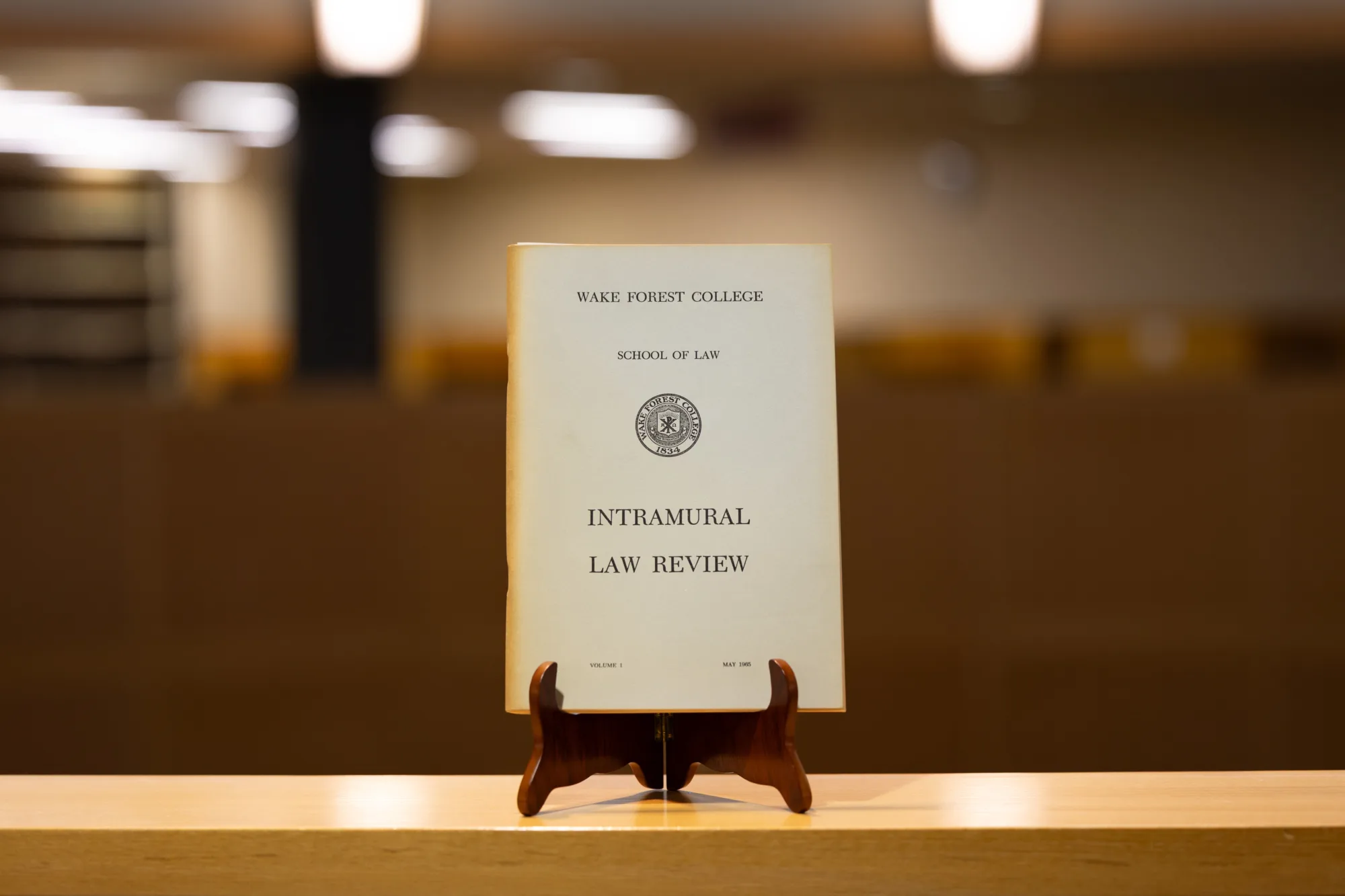
One of the students approached the heads of the school about starting a law review. The administration, led by Dean Carroll Weathers, was not as enthusiastic about the idea as the students had hoped, primarily due to budgetary constraints. “They were concerned first about the financial impact,” says Bill. “But secondarily, they seemed concerned that we would start a law review, then lose interest in it and it would not survive, which would have reflected poorly on the school.” But there was a compromise to be made. “They gave us an office in the basement of Carswell Hall and allowed us to establish the Wake Forest Intramural Law Review”—the word “intramural” providing the necessary amount of separation from an official enterprise of the Law School!
“We never had any doubt we’d make it happen,” says Bill. “We had a lot of confidence. We just said, ‘What’s it going to take to make it succeed and carry on?’ We felt like the students really wanted it, and there were plenty of dedicated, excellent students who could make it happen.” Additionally, many of the faculty members were very supportive of establishing a law review. “We just had to get the funding,” Bill says. The students took their proposal to the Student Bar Association (SBA), which voted to assess all students an additional $3 per year to support the law review. “I don’t recall any negative votes,” says Bill.
But the funds from the SBA, about $550, were not enough. So, the group had to think more broadly. They decided to run advertisements and approached a number of local businesses who they thought would be interested in placing ads in the new law review. Wachovia Bank, Northwestern Bank, and Michie Company (now known as LexisNexis) advertised in the first issue, paying a combined total of approximately $2,000. That produced a total of slightly over $2,500 with which to get the first law review typed, printed, and distributed.
With the funding in place, Bill and his fellow board of editors members, Gary Davis, Joseph Radzius, Charles Wray, Jr., Edmund Liles, and James Van Camp, set to work putting together the first issue. Bill enjoyed the detail-oriented work, especially the writing and editing process. “We had to make sure everything was accurate, that the structure was solid.” Once the writing and editing were completed, they found someone on university staff who they paid to type the articles in proper form, and then they took it to the printer.
The first issue of the Wake Forest Intramural Law Review was published in May 1965 and contained 9 articles, written by members of the law review’s board of editors as well as other students. Approximately 500 copies were made, and each of the Law School’s students received one.
In the Introduction of the first issue, the board of editors wrote:
During the Spring Semester of the 1964 academic year the Student Bar Association of the Wake Forest College School of Law approved the establishment of an intramural law review at the School of Law. The Law Review is completely supported by the law students by means of a voluntary increase in the Student Bar Association dues.
The Wake Forest Intramural Law Review has one outstanding purpose—to provide the law students at Wake Forest an opportunity to gain experience in the discipline of mature and creative legal writing in unsettled areas of Anglo-American jurisprudence. Also, it is hoped that the Law Review will give members of the North Carolina Bar tangible evidence of the ability of Wake Forest law students to engage in comprehensive legal research and to convey effectively the legal principles which such research produces.
There’s Something So Cool in Caring That Much
“It was a very positive experience,” says Bill, of his time creating and working on the law review. “Other than the occasional extra night of work on a Saturday or Sunday!” Although those weekend nights weren’t always so bad. Bill and his girlfriend Myrtie (who later became his beloved wife of 57 years) would occasionally end up in Carswell at the Law Review office on a Saturday or Sunday night, where Bill would work on the Law Review and Myrtie would do second grade teacher duties.
Being around friends was always important to Bill, who says the most memorable aspect of his time on the law review was the camaraderie; working with the folks on the board, all of whom were very close friends, including classmates Rhoda Billings (who later went on to become the first female law professor at Wake Forest Law and Chief Justice of the North Carolina Supreme Court), Leary Davis (who was the founding dean of the law schools at Campbell and Elon), Jim Williams (who was named the top trial lawyer in North Carolina), and Fred Smith (who served in the NC General Assembly).
Will, who took up the mantle of editor-in-chief of the Wake Forest Law Review for the 2025-2026 academic year, agrees. “Law school can be such an individual experience. You can focus only on your grades and getting a job, and really only interact with a few people,” he says. “Law Review has been such an important part of my time at law school, in part because it’s an opportunity to work with some of the smartest people in the school toward a shared goal.” He values not only the physical product at the end, but also the process of spending countless hours producing something he can be proud of.
He continues: “Years down the line, when I’m looking at my copies of the Law Review, I can look back and think about the work that we put in trying to make it perfect, but also all the time we spent getting to know each other and coming to appreciate each other’s talents,” he says. “There’s something so cool in caring that much about something, alongside others who care just as much.”
While that sense of care and collaboration certainly won’t change, other things are rapidly changing.
Will views the present day to be a very interesting time to be involved with the Law Review because of all of the change. With everything being so accessible online, Will wonders if there’s a place for print anymore. “You see a lot of journals, although not necessarily flagship journals, deciding to be accessible only online and have no print versions. I hope that doesn’t happen,” he says. “I hope we’re able to keep printing physical copies.”
Another point of friction is the prevalence of AI. Will—like essentially all of humanity—is curious to see how AI will change law review articles and the process of putting together an issue. “You are already seeing law reviews around the country instituting policies about disclosing the use of AI,” he says. “We actually had someone reach out to us who was starting to develop an AI tool specifically for blue-booking.” Will thinks about how that will change the process and workflow for the Law Review. “What does your role on a law review look like if you’re a 2L and half of your job is checking that citations are correct, but now an AI tool can do that in 15 seconds?” Despite significant technological advances, Will hopes that the Law Review will continue to provide excellent training on being detail-oriented, putting in effort to ensure things are accurate and of high quality, and learning how to work under deadlines.
For Will—who will be clerking in the Western District of Virginia for Judge Thomas Cullen and then joining Robinson Bradshaw in Charlotte to practice litigation—that strong sense of community is what he will miss the most when he graduates. “I can’t speak highly enough about the experience I’ve had at Wake Forest Law. I feel so lucky to have come here. I hope Wake Forest Law always holds onto its collegiality and warmth, and being a place where people care about building each other up and helping each other get to where they want to be. That’s truly what sets Wake apart.”
Bill agrees. “A friend of mine who was President of Davidson College once advised in a speech to the bar association, ‘Honor the mystery of your roots,’” referring to the duties and traditions that have made the legal profession so important, recalls Bill. “And so, I think it’s important for any institution to remember its core, why it’s there, its purpose. Sure, you should try to improve and change and get better, but don’t abandon your essence.” It’s not hard to see that community is at the root of Wake Forest Law—and so much has grown and bloomed from that.
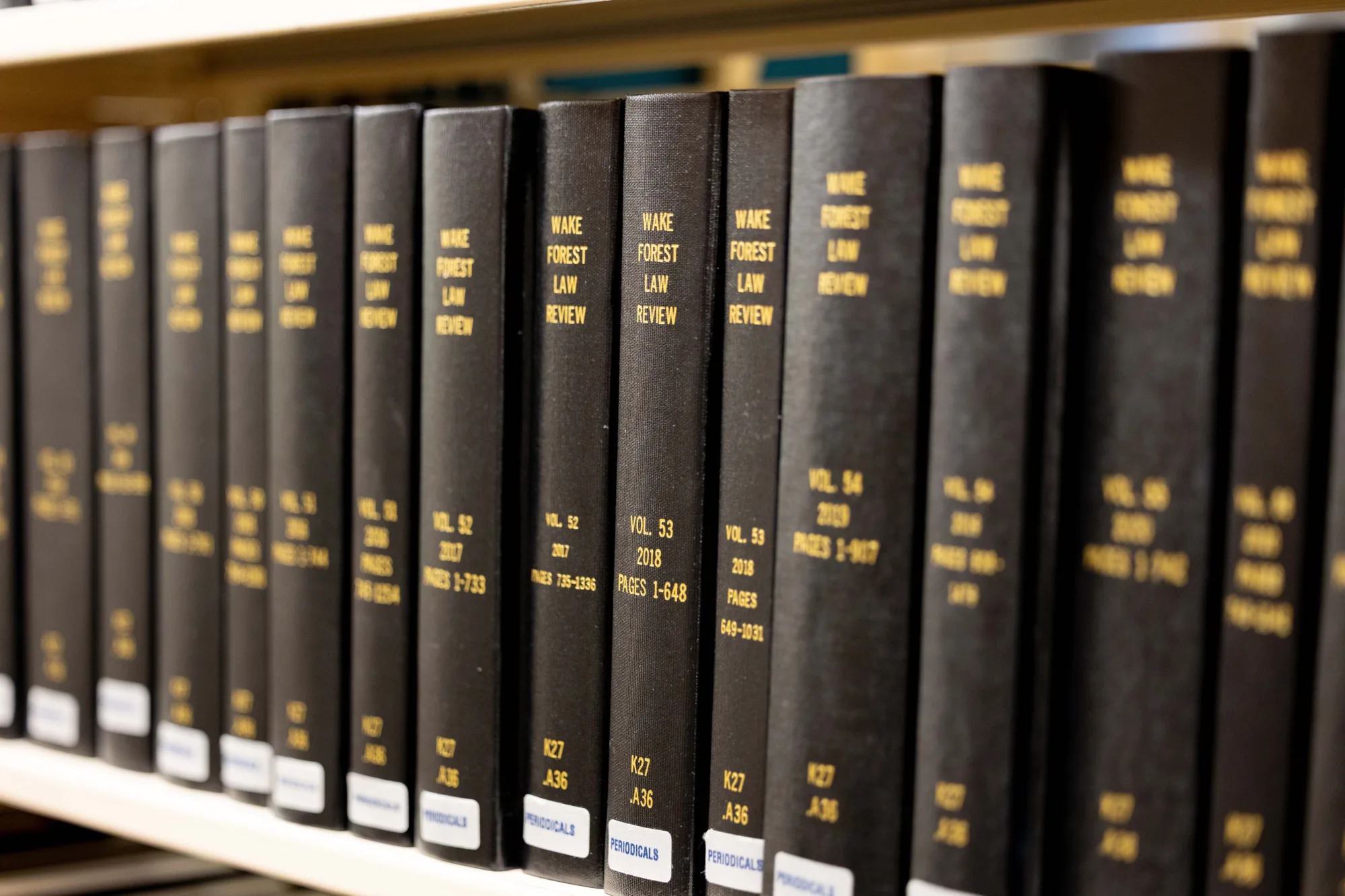
Bill and his fellow students were right. They made it happen. They started a law review that they—and future generations—could be proud of. And in 1970, the Wake Forest Intramural Law Review officially became the Wake Forest Law Review, as it is still known 60 years after its birth.
Categories: Our People